How Many Seconds Are in a Day? Easy Explanation and Calculations
SEO Title: How Many Seconds Are in a Day?
Meta Description: Learn how many seconds are in a day with simple formulas, examples, and real-life uses of time conversion.
Time passes quickly, but have you ever thought about how many individual seconds make up a single day? We usually measure time in hours or minutes, yet every day is actually built from thousands of tiny seconds ticking by one after another.
Knowing how time conversions work can help in school, science, programming, fitness tracking, scheduling, and everyday problem-solving. Once you understand the basics, converting between hours, minutes, and seconds becomes very simple.
The Exact Number of Seconds in One Day
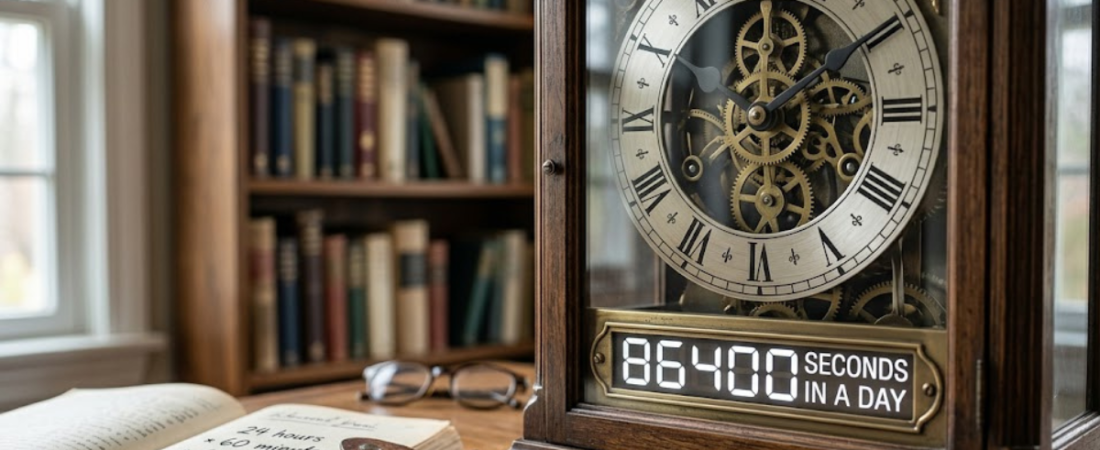
A standard day contains 86,400 seconds.
The calculation comes from:
- 24 hours in a day
- 60 minutes in each hour
- 60 seconds in each minute
Here’s the formula:
genui{“math_block_widget_always_prefetch_v2”:{“content”:”24\times60\times60=86,400″}}
So, a full 24-hour day equals 86,400 seconds.
Step-by-Step Time Conversion
If you want to calculate the total yourself, follow these simple steps:
- Start with 24 hours
- Multiply by 60 minutes
- Multiply by 60 seconds
This gives:
- 1 hour = 3,600 seconds
- 1 day = 86,400 seconds
Once you remember these relationships, larger calculations become much easier.
Seconds in Multiple Days
Two Days
To find the number of seconds in two days:
genui{“math_block_widget_always_prefetch_v2”:{“content”:”86,400\times2=172,800″}}
Two full days contain 172,800 seconds.
Ten Days
For ten days:
genui{“math_block_widget_always_prefetch_v2”:{“content”:”86,400\times10=864,000″}}
Ten days contain 864,000 seconds.
Seconds in a Year
A regular year has 365 days. To calculate the total number of seconds:
genui{“math_block_widget_always_prefetch_v2”:{“content”:”365\times86,400=31,536,000″}}
That means a standard year contains 31,536,000 seconds.
Leap years include one extra day, so the total is slightly higher.
Why This Conversion Matters
At first, the number may sound like simple trivia, but it has many practical uses.
Science and Engineering
Scientists often measure events in precise units of time, especially during experiments and calculations.
Computer Programming
Software and digital systems frequently use seconds for:
- Timers
- Timestamps
- Scheduling tasks
- Server synchronization
The number 86,400 commonly appears in coding because it represents one complete day.
Sports and Fitness
Athletic performance is often measured down to the second or even millisecond.
Productivity and Planning
Understanding how time adds up can help with scheduling, focus, and better time management.
Interesting Time Facts
Here are a few quick facts related to daily time calculations:
- One day contains 1,440 minutes
- One week contains 604,800 seconds
- A month can contain more than 2.5 million seconds
- An hour contains 3,600 seconds
Seeing time in numbers makes a day feel surprisingly short.
Common Mistakes in Time Calculations
Multiplying by 60 Only Once
Some people forget to multiply by 60 twice when converting from hours to seconds.
Mixing Up Minutes and Seconds
Keep these basics in mind:
- 60 seconds = 1 minute
- 60 minutes = 1 hour
Forgetting the 24-Hour Day
Time conversions are based on a full 24-hour day, not a 12-hour clock.
Easy Calculator Method
The fastest way to find the total seconds in any number of days is:
- Days × 24 × 60 × 60
This simple formula works for almost every standard time conversion.
Frequently Asked Questions
How many seconds are in one day?
A standard day contains 86,400 seconds.
Why does a day equal 86,400 seconds?
Because:
24 hours × 60 minutes × 60 seconds = 86,400.
How many seconds are in 48 hours?
Forty-eight hours contain 172,800 seconds.
How many minutes are in a day?
There are 1,440 minutes in one day.
Is every day exactly 86,400 seconds long?
Most days are, although scientific time adjustments can occasionally create small differences.
Why do programmers use 86,400?
It represents one complete day in seconds, making it useful for automation, software scheduling, and timestamps.
Conclusion
Learning the number of seconds in a day is a simple but useful part of understanding time conversion. Whether you are solving math problems, writing code, tracking performance, or satisfying curiosity, this calculation appears more often than you might expect.
The most important number to remember is easy:
One full day contains 86,400 seconds.