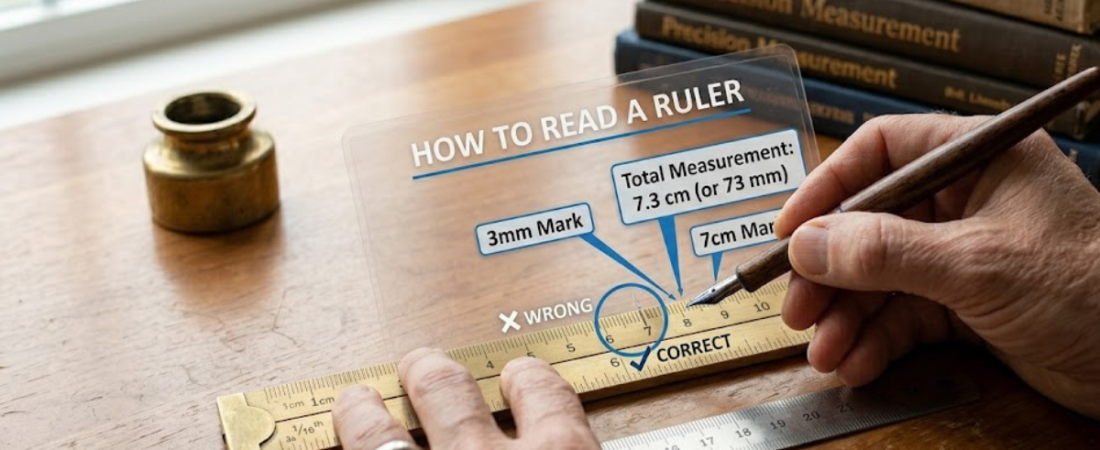
At first glance, a ruler can look surprisingly confusing. With all the tiny lines, numbers, and markings, many people aren’t sure where to start. But once you understand what each line represents, measuring objects becomes quick and easy.
Learning how to read a ruler is an essential skill used in school, construction, crafts, sewing, woodworking, and everyday life. Whether you’re measuring paper, furniture, or a DIY project, understanding ruler measurements helps you work more accurately and confidently.
What Is a Ruler?
A ruler is a measuring tool used to determine the length or width of an object. Most rulers display two measurement systems:
- Inches
- Centimeters and millimeters
Some rulers show only one system, while others include both metric and imperial measurements on opposite sides.
Understanding the Two Main Measurement Systems
Before reading measurements, it helps to understand the difference between the systems.
Imperial System
The imperial system uses:
- Inches
- Feet
- Yards
In the United States, rulers commonly use inches divided into smaller fractions.
Metric System
The metric system uses:
- Millimeters
- Centimeters
- Meters
This system is easier for many people because it works in multiples of ten.
How to Read a Ruler in Inches
The inch side of a ruler contains numbered sections divided into smaller lines.
The longest numbered lines represent whole inches.
For example:
1 inch=16 smaller divisions1\ \text{inch} = 16\ \text{smaller divisions}
Each smaller line represents a fraction of an inch.
Understanding Inch Fractions
Most standard rulers divide inches into:
- 1/2 inch
- 1/4 inch
- 1/8 inch
- 1/16 inch
The line length helps identify the fraction.
Half Inch Marks
The second-longest lines represent halves.
Example:
12=0.5\frac{1}{2} = 0.5
Quarter Inch Marks
Slightly shorter lines show quarter-inch measurements.
These include:
- 1/4
- 3/4
Eighth Inch Marks
Smaller lines divide the inch further into eighths.
Sixteenth Inch Marks
The shortest lines usually represent sixteenths.
These provide more precise measurements.
Step-by-Step Guide to Reading a Ruler
Breaking the process into steps makes measuring much easier.
Step 1: Find the Starting Point
Place the object at the zero mark on the ruler.
Be careful not to start from the edge if the ruler has extra spacing before zero.
Step 2: Locate the Last Whole Inch
Find the largest numbered inch before the object ends.
Step 3: Count the Fraction Lines
Identify how many smaller marks appear after the whole inch.
Step 4: Combine the Measurement
Put the whole number and fraction together.
For example:
3+14=3143 + \frac{1}{4} = 3\frac{1}{4}
That measurement would be read as “three and one-quarter inches.”
How to Read a Metric Ruler
Metric rulers are often simpler because they use decimal-based measurements.
Centimeters
The numbered lines usually represent centimeters.
Millimeters
The smaller lines between centimeters are millimeters.
There are:
1 centimeter=10 millimeters1\ \text{centimeter} = 10\ \text{millimeters}
This makes metric rulers easier for precise measurements.
Common Ruler Measurement Examples
Here are a few examples to make measurements clearer.
Example 1
If an object ends halfway between 2 and 3 inches:
2+12=2.52 + \frac{1}{2} = 2.5
The measurement is 2½ inches.
Example 2
If the object reaches the fourth small line after 1 inch on a 1/16 ruler:
1+416=1141 + \frac{4}{16} = 1\frac{1}{4}
The measurement is 1¼ inches.
Example 3
If the object reaches 7 small metric lines after 3 cm:
The measurement is 3.7 cm or 37 mm.
Tips for Measuring Accurately
Even small mistakes can affect measurement accuracy.
Follow these simple tips:
- Start exactly at zero
- Keep the ruler flat
- Measure at eye level
- Avoid angled viewing
- Use the correct side of the ruler
Careful positioning improves precision significantly.
Common Mistakes Beginners Make
Many people struggle with ruler reading at first.
Common errors include:
- Starting from the ruler edge instead of zero
- Confusing fraction lines
- Mixing metric and imperial sides
- Miscounting small divisions
- Reading measurements at an angle
Practice helps eliminate these mistakes quickly.
Why Learning Measurement Skills Matters
Ruler-reading skills are useful in many real-life situations.
These include:
- School assignments
- Home improvement
- Sewing and crafts
- Woodworking
- Architecture
- Construction
- Cooking and baking
Good measurement skills improve accuracy and reduce waste in projects.
How Children Can Learn Ruler Reading Faster
Kids often learn measurement more easily with visual practice.
Helpful activities include:
- Measuring toys
- Drawing measured lines
- Using colorful rulers
- Comparing object lengths
- Practicing fraction recognition
Hands-on learning usually works best.
Frequently Asked Questions
What do the small lines on a ruler mean?
The small lines represent fractions of an inch or millimeters, depending on the ruler type.
How many millimeters are in one centimeter?
One centimeter equals 10 millimeters.
Why are some ruler lines longer than others?
Longer lines represent larger measurement units, making them easier to identify quickly.
Which ruler system is easier to read?
Many people find the metric system easier because it uses decimals instead of fractions.
How do I measure accurately with a ruler?
Start at zero, keep the ruler straight, and read the measurement at eye level.
What is the smallest measurement on a standard ruler?
Most standard inch rulers measure down to 1/16 of an inch.
Conclusion
Learning how to read a ruler is a practical skill that becomes easier with practice and repetition. Once you understand how inch fractions and metric divisions work, measuring objects accurately feels much more natural.
Whether you’re working on school projects, crafts, DIY repairs, or professional tasks, accurate measurement skills can save time and improve results. Start with simple measurements, practice regularly, and soon reading a ruler will feel effortless in everyday situations.